”Derived Concepts of Shinto"
”Fundamental Concepts and Commentary on Shintoism”
Kazushi Kurokawa
4/4
Ⅳ.Derived Concepts
-Wabisabi Culture(侘-寂)
One concept of the Musubi, "the melting of boundaries between Nature and Culture," specifically, is that the culture is eroded by nature over time, then "Wabisabi" occurs because of it. Wabisabi is basically a concept defined later than Shinto, such as the beauty of imperfection. However, the concept of wasabisabi exists widely in Shinto Culture from ancient times, in the concept of musubi and the architecture of Shinto, and so on. In addition, the wabisabi culture which has the tranquility of accepting fluid changes and reverence for old things, fosters the culture of Tolerance of diversity such as yaoyorozu no Kami ( 八 百 万 の 神 ) and the "fermented culture" and maintain the harmonies and suppress the Opposition axis in the cultural development and history of Japan. Fermented culture is the essence of wabisabi. It's not just a fermented food made from koji mold. It is a Culture that ferments even things. Art, environment and culture, and finding great value in the accumulation of history.
Although many superior functional products will be produced in future generations, the "aging, fermentation" which requires investments in time will not be overturned by the efforts of future generations. This fermentation of culture will strengthen "sustainability," which is an important issue for developed countries. Modernized society, for example, has a weakly sustainable consumer structure, but in fermentation culture, the objects and values that have already been fermented (traditional) are reconstructed into modern society to give "old and unusable things" "new values to live in the present". In order to respect harmony based on natural rationalism and not confrontation, it is desirable to keep history conservatively and to make culture evolve fluidly "fermented". As a result, Shinto is able to flexibly adapt to cultural development while maintaining "sustainability."
-The concept of Kegare(穢れ)
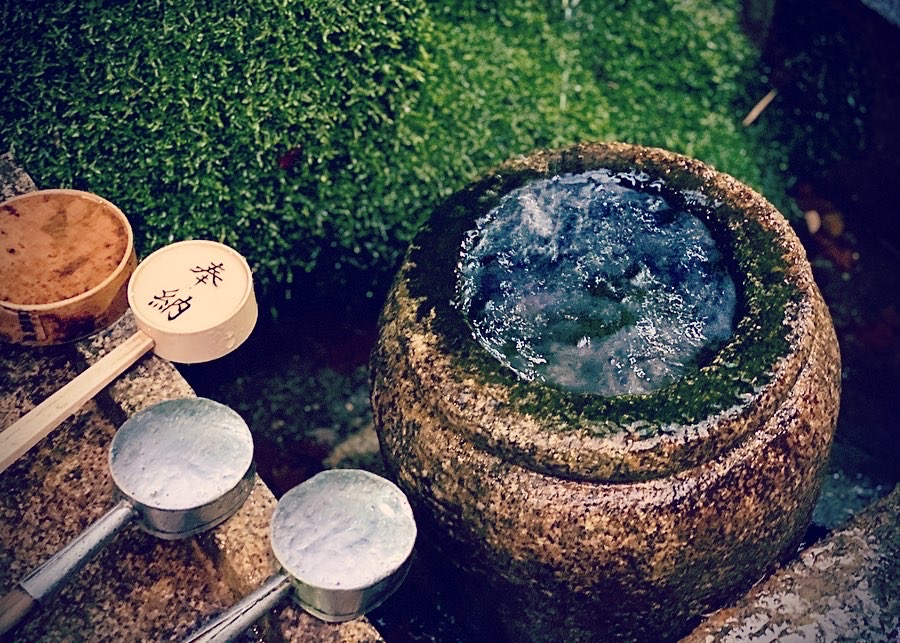
It is basically the concept of "public sanitary" of Shinto. Kegare is a method and idea which was formed in the harmony and Seamless culture of Shinto. In the latter interpretation, the term "Kegare(穢れ)" is also translated as "withering of sprit( 気 枯 れ ) ," However, that interpretation was used to maintain religious "psychological hygiene" based on later Buddhism. In the value of Shinto, the concept of kegare is a practical idea for maintaining public health, this is a more Shinto concept. In ancient Japan, which had long been highly collective society, the boundaries between the public and private sectors have become blurred. So, they used the concept of Kegare and built a system to maintain public health and risk hedge. For example, Shinto thinks, dead bodies, rotting substances, blood, and infections are "kegare". And Shintoism avoids those things, as kegare to avoid that risk of plague and infection. In Buddhism, they did not avoid matter of the "death" or filth, as kegare. But in Shinto, they avoid matters related the death in daily life for the public health. Shinto requires people to wash their hands and mouth before entering the shrine. In the Heian period, when this concept of poverty was established, plague spread throughout the city, and "public health" was an urgent task for to be dealt with. As you can see, Kegare is an idea adjusted to the social conditions of at the time of Japan. It is a mixture of the ideas of public health in practical mind of Shinto, and the religious mind of Buddhism which is purifying the mind and cleansing the soul of sin. These Shinto ideas could greatly contribute all over the world if it is readjusted in modern society again as a solution to the various problems facing the modern world, such as the problem of medical insurance and the increase in social medical costs.
Ⅴ. Summary
So far, I have explained "the fundamental concept of Shinto" as "The thoroughbass of Shinto", "Divisions in Shinto", "Basic Concepts of Shinto", and ''Derived Concepts of Shinto". Of course, since many scholars are doing research, many interpretations will exist. However, as mentioned above, the content mentioned in this essay is a "fundamental and essential part of Shinto " and based on these basic structures of Shinto, each addition of various interpretations in literature and religious ideas had appeared in japan. There are two very important points to be made, It must Clearly separate The State Shinto that is nothing but a national policy of the Meiji era, which is regarded by the international community as a symbol of Fascism from Original Shinto which has the idea of the harmony between nature (Kami)and culture (human), as Original Shinto has exact opposite idea of Fascism. Also, it must separate the concepts of "God of the West" from concept of "Kami of Shinto." These two points are a prerequisite. If you do not consider these two points, there is a possibility that will became far from original Shinto.
Similar to the imperialism of the state Shinto which was carried out by the Meiji government at past through the deification of the Emperor are not Original Shinto, and religious influence beyond the faith of Shinto style of Animism, will lead to be cult religion rather than Original Shinto. For example, consider the Kami or emperor is the Absolute god. This kind of thinking Is not Shinto anymore. Even though there is a part of Animism faith in Shinto, Shinto is not a "religion". There are no precepts, doctrines, or founders of Shinto. It's a cultural concept like wabisabi, Bushido and cha no yu. This is the reason Shinto does not need to stop any people who want to participate in it due to differences in religion, nationality, or race. The main characteristic of Shinto idea is the development of human culture through coexistence with nature and nature rationalism.
Also, Shinto does not try to achieve any religious enlightenment. Japan seems like a mono-ethnic island nation at first glance, but it is actually an "ancient multiethnic nation" like the United States currently. Of course, the exact meaning of "multi-racial" is not exactly the same in ancient Japan and the United States. However, the idea of "connectivity" in Shinto were raised because of the "multi-ethnic society of ancient Japan." These Shinto ideas are adaptable in today's Planetary boundary and diversity in modern societies. Details of those area will be summarized in the next other essay. I propose that by rediscovering the fundamental concept of Shinto, it can contribute to the development of modern society as well.

”Basic Concepts of Shinto”
”Fundamental Concepts and Commentary on Shintoism”
Kazushi Kurokawa
3/4
III. Basic Concepts
The previous sections have defined the fundamental concepts of Shintoism, and the misunderstanding of the image has hopefully been resolved. However, these are only a part of the structure of the Shinto. To understand the Culture and idea of the Shinto, a further "conceptual understanding" is needed.
Among them, “The concept of KAMI”, “The concept of MUSUBI”, and the concept of "NATURE RATIONALISM " is the "basic concept" following the thoroughbass in Paragraph [I]. In addition, "Wabi Sabi" and "Kegare", which are explained in the next section, can be said to be "derivative concepts" that embody the concept of Shinto in the continuous history and culture of Japan. Finally, by understanding these basic and derived concepts, we may conclude the purpose of this article, "the Interpretation of Basic Concepts of Shinto."
-The Concept of KAMI
When you try to talk about Shintoism with the concept of modern society, some misconceptions occur. One of them is the definition of Kami. The concept of "kami" in Shinto differs from "God" and "shén" in other cultures. Particularly, Kami is translated as "God" in English. And the god of polytheistic religion is translated as "gods". this caused the issue of misleading that "Isn't the Emperor and Amaterasu- oomikami the Absolute God which the Japanese are worshipping?" As mentioned in paragraph (1), the thoroughbass of Shinto, In Shintoism, "Kami" is an honorific title that "personifies" familiar matters such as the sun, earth, agriculture, and houses. It is not the Transcendental and Inviolability of absolute beings. It is nothing more than the meaning of respect and awe of nature for its greatness.
Personification can be said to be, in some sense, an apposition to human beings and their nature. However, in the West, the concept of God is "a Transcendental and Inviolability absolute God".
Therefore, Kami and God are very different concepts and not appropriate as a translation at all. In other words, in Shinto, the "kami" is a reverence of the things that support the "sustainable life activities" of human beings. Neither Kami nor man expects each other to be Transcendental absolute beings. In Shinto, Humans are just Humans, as we are, as nature is just nature. And Kami is only a noun and a personification of each natural phenomena that humans and nature have carried out in order to "coexist" (supply and demand, harmony).
-The concept of MUSUBI(結び,産霊)
Basically, Shinto gods are personifications of nature. It can be said that this is like the idea of "Animism," which has occurred in many parts of the world. However, there is a different concept from Animism on the other hand, called "Musubi". Musubi ideas are treated not as religious idea but also as symbols of biological "life activities" such as sex and childbirth, as tied to nature (kami) and the culture (human beings). Also, as mentioned in the previous sections, in order to achieve the purpose of the Shinto, "Sustainable Life Activities," it is impossible to achieve this by only worshipping Nature Blindly. And it's impossible to despise Nature and aim only at the development of human Culture. The structure of the world in which mankind lives is not dualism but a gradation structure which is connected from a highly civilized society to pure nature. Musubi (tie, the main function of Shinto) exists in the space between Nature (Kami) and Culture (human) and it connects the two. Shinto exists on the boundary between nature and culture. It is the image of a rope, a symbol of life, connecting Nature and Culture. These are also seen in the religious aspects of Shinto, the idea of life and death. In Shinto, ancient sacrifice was not a punitive concept such as "sacrifice for forgiveness of human sins." But sacrifice was thought of as a marriage of the between kami and human, and becoming a relative, and trying to suppress separation of nature and human, it was the intended idea of reconciliation and harmony between nature and humans. It was for deepening the connection between Nature and Culture. In Shinto, they personify the Kami and consider them an extension of their family, and Shinto does not worship Kami as an absolute God, but Shinto thinks human and Kami are connected to each other. This idea of musubi can be seen not only in the Jomon people in mainland Japan, but also in other people of Jomon descent such as Ainu and Native Americans.
-The concept of The Nature Rationalism
Broadly speaking, it is making rational judgments based on nature. Nature, in this case means "the rule and the principle" of nature. It means making rational decisions according to the rule and the principles of the nature, not by your position or your emotions or your culture or your religion. It may sound a bit similar of the an "unbiassed policy" of Xun Kuang who is the scholar of the Confucianism in China. But nature rationalism is based on the rule and principles of the nature itself. It is not some thought of spiritualism or religious thinking but is instead based on more practical thinking, like survival tactics of the ancient human beings, which rather similar concept of the sciences of nowadays. For example, even in the definition of a kami, it was not considered to be an absolute god to worship, but all the things contributing to life activities are seen as Kami and respected by the people. But also, Shintoism does not necessarily worship nature blindly. In the event of natural disasters, there are also times when civilizations fight against nature using technology. For example, Ancient Japanese set up a double fence for this. In the Shinto mythology, there is shown to be a monster, Yamata no Orochi (giant snake which has eight head), It was symbol of floods, and it is telling of how humans fought against floods in ancient times. In the Musubi section, it pointed out that the world is a gradation structure, not a dualism, and that Shinto exists at the boundary between the two. This Musubi idea also encompasses nature rationalism. Usually, because of the way the human brain functions, we often judge by dualism, such as like justice and evil, men and women, lightness and darkness. However, in the real world there is always diversity, and it is required to make decisions based on the rule and principles of the nature. And in this modern age this concept must include the academic study such as biology, math, science, and even market principles. In this practical thinking of Shintoism, spiritualism or religious thinking is not truly a Shinto way of thinking. This "nature rationalism" is a term I have come up with but combining nature with practical rationality is an important idea for comprehensively capturing Shinto concepts, and it is the basis of the original Shinto mind. This shows that Shinto is more realistic, practical and less spiritual or religious than any other animism.
”Divisions in Shinto”
”Fundamental Concepts and Commentary on Shintoism”
Kazushi Kurokawa
2/4
Ⅱ.Divisions in Shinto
As mentioned in the previous section, there are many proposals for different forms/branches of Shinto today. This is probably the reason why not only Japan, but other countries have given the wrong image of Shinto. In order to resolve this misunderstanding, we will examine three important branches.
-State Shinto
First, due to The State Shinto at the Beginning of Meiji Japan, many people thought that Shintoism was not a religion. In the beginning, the Meiji government, based on the concept of Separation of politics and religion took the position that Shinto was not a religion, as an interpretation of public law (Jinja hi Shukyo ron 神社非宗教論). However, as a countermeasure against Christianity in Japan, the Japanese government used Shinto for official national religious activities. In addition to this, the Japanese government deified the Emperor, who has a high authority of the history as the diplomatic strategist. The Meije Japanese government then implemented a DeFacto "Shinto as the national religion of Japan" in such places as system of ranked Shrines and created an Imperial Rescript on Education.
This was "National Shinto," and it was treated as "a symbol of Fascism" by GHQ after Japan’s defeat. In other words, the national Shinto (国家神道) was the national religion carried out under national policy based on the "Imperialistic idea" of the Japanese government of at that time, which is completely different from the original Shinto. Also, the true authority of the Japanese Emperor (which is based on the long history of japan) are different from the State Shinto which was made by Meiji Japanese government. The State Shinto was one of the Japan's detailed diplomatic strategies for the modernization and for the suppressing the colonization of japan from Western countries.
-Imperial household Shinto
Second, Imperial household Shinto (Koushitsu Shinto 皇室神道). Since the State Shinto was based on this imperial household Shinto, a lot of people confuse the two, but they are different from each other. It is a traditional Shinto practice of the Japanese Imperial family, which branched off from the Tenson tribe (天孫族) of the Amatsu Kami (天津神). The Imperial family came to the Japanese archipelago from the Jomon period to the Yayoi period and ruled Japan. So, this Imperial Shinto has its own long history, tradition and ancient rituals which have nothing to do with the State Shinto which was made by the Meiji government from the diplomatic strategy. Imperial household Shinto was first founded by the first Emperor Jinmu, who is said to be from the Amatsu Kami (天津神) lineage, ruled Japan after the battle between the Amatsu Kami (天津神)and the Kunitsu Kami (国津神) in the record of Kojiki (古事記). Amatsu Kami 天津神 and kunitsu kami 国津神 are both the people who come from overseas and settled in japan as traijin 渡来人. Kunitsu Kami settled in japan before the Amatsu Kami.
So, there was a battle between them to decide which of tribe rules Japan. (Kuni yuzuri 国譲り). While the State Shinto was based on the imperialism as the national religion of Meiji japan, on the other hand, the Imperial household Shinto was not religious, but based on a political system of domestic autonomy, the record of the history and technology, and for the diplomacy of the ancient times.
Since Shinto was originally based on the "sustainable life activities," of the ancient people, the values of original Shinto remained deep in the Imperial household Shinto and promoted the prosperity of the nation. It became a highly developed culture that was a mix of the culture of Jomon period, the early Shinto view at shrines, and festivals with continental culture.
-New Shinto movements
Thirdly, New Shinto movements from the Edo period to the Meiji period, "Koku gaku (国学)" influenced by the Sonno joi (尊王攘夷)movement, became popular. Kokugaku was trying to research ancient Japanese idea (but even included political thoughts and new interpretations of some part of mysticism) and trying to redefine Japanese culture. As the part of Kokugaku movement, theories of Restoration Shinto (fukko 復古神道) and Kannagara (かんながらanother name for Shinto which is/was used in mostly Kokugaku contexts) was promoted. In addition, during that age, there are also many thoughts of syncretism and spiritualism as new movements appeared. For example, Miwa Ryu Shinto (三輪流神道). The reason why many of these new Shinto movements were born was probably because of that, in spite of the fact that Shinto has no doctrines or founder but still, so many Japanese value the traditional culture and festivals from ancient Japan, Shintoism had a high affinity for other religions and ideas.
However, these new Shinto movements have developed differently from the original Shinto, along with the Shinto context as a sublimation of culture. If we look at the bifurcation of Shinto, we can see that many images of Shintoism currently are derived from this "branching and later-occurring Shinto" and not the original Shinto. For example, the image of "Fascism" comes from the Meiji government's national policy of the state Shinto. The image of Shinto as "religion or spiritualism" comes from New Shinto movements, especially, it must be handled in a context completely different from the original Shinto and the Fascism concept. This is because the original Shinto and Fascism are total opposite ideas. Original Shinto values the prosperity of Every living thing, by the ties between Nature and Culture.

”Fundamental Concepts and Commentary on Shintoism”
"Fundamental Concepts and Commentary on Shintoism”
Kazushi Kurokawa
1/4
[Introduction]
From ancient times, the Japanese “Shinto” culture has existed, and it is an essential part of Japanese culture and of Japanese history itself. It has strong ties to the Japanese Imperial family and the national policy of Diplomacy.
Shintoism puts forward the idea of living in harmony with nature, and this can contribute to the controversial topic of “Planetary Boundaries” that has developed from the diversification fo modern societies.
In many countries, including Japan itself, Shinto religion is not properly understood, and some have the impression from World War II that it is a "Symbol of Fascism," "...just a national religion of japan based on polytheism,” or "...one of the foreign ideas such as Taoism and Confucianism,” but these are not the essence of Shinto at all. Now, let's look at what the essence of Shinto is, and examine the Fundamental concept of Shintoism.
Ⅰ.The Thoroughbass of Shinto
Throughout the history of Shinto, there have been many different branches, each of which forms its own different interpretation and culture.
However, even in the interpretation of these branches of Shintoism, there are concepts that influence the system as common preconditions and core concepts; this is essential to unraveling Shintoism.
In this section, we will briefly review and define the fundamental part of Shinto in two ways: structure and concept.
Ⅰ-Ⅰ.Shinto’s Assumption as a Structure
The beginning of Shintoism was formed spontaneously based on Animism faith, as part of the collective common illusion of the Homo sapiens, which supported the universal development of mankind.
But this begs the question, is Shintoism a religion or a culture? This question changes the interpretation of each branch of Shinto greatly.
A lot of people tend to imagine that many modern religions blindly believe their founder as a being of absolute invulnerability and carry out their will irrationally.
Isn't this also the case with extreme Nationalism or the impressions of The State Shinto at World War II?
In order to get answers to these questions, a definition of the religion is necessary. This is quoted from the World Religion Dictionary by Murakami Shigara,
regarding what makes a religion "...it has a specific concept that recognizes transcendental existence, and a social group with a doctrine, rituals, facility, organization, etc, based on its ideological type." Traditional rituals, traditional culture and historical shrines exists within Shinto as Matsuri and Yashiro in the long history of Japan.
However, Shinto has a lot of missing parts as a "religion".
- There's no canon.
For example, Shinto does not have the Canon, a Founder, a Central organization, doctrine, or Absolute deity (the God) to worship.
In Shinto, a group of academical materials that meet certain requirements is called the "Sacred Book", but it is still a study, and there is no official scripture. Therefore, there are no doctrines, or precepts, and even the oldest Japanese book "kojiki", which is regarded as a Shinto scripture, plays a major role in
historical records, such as the movement of peoples and the technical transmission of tools, agriculture, clothing, and housing.
- The organization doesn't exist.
Original Shinto does not have the historical central organization who worship the founder of Shinto and follow the doctrine. There is no provision on the founder of Shinto itself as well.
For example, the shrine headquarters (Jinja Honchou 神社本庁) established only in 1946 (Showa 21), and the Imperial Household Agency (kunaicho 宮内庁) , which is under the jurisdiction of the Prime Minister for the politics of The State Shinto.
Originally, there is only each historical shrine, ritual and Priest in Japan from the ancient times as the cultural center of each local place.
- There is no absolute God.
There is no absolute deity in Shinto. It is estimated that the beginning of Shinto was formed spontaneously, based on Animism faith as part of the collective common illusion of the Homo sapiens, which supported the universal development of mankind.
Emperor Jinmu (the first Emperor) is just who won the interethnic strife in Japan and is regarded as the founder of Imperial family of Japan. And Amaterasu-Ogami which appeared in the mythology of imperial Shinto is the embodiment of the sun.
We will analyze the details with the concept of "KAMI", which we will discuss later in a specific section, but it is true that nature such as the sun is beyond human intelligence. It is only natural that there is more physical energy than human beings, and it is not defined as the act of recognizing an existence as transcendent.
In other words, since there is no orthodox doctrine or organization, and there is no transcendental existence as a precondition for religion in the first place, it is difficult to define Shinto concepts as "Religion". Shouldn't we define them as "cultural forms" Of course, the term "Shinto" as used here refers to a primitive ideological system, so it does not include any religious corporations or ideas that sprout during modernization. This will be discussed in paragraph Ⅱ.